


Readings for today: Genesis 10-11
One of the great blessings of my life is I get to travel around the world. I have been to the Far East and spent time with believers in China and South Korea. I have been to Mexico and spent time with believers there. I have been to the Middle East and talked to believers in Israel and Jordan. But most of my time is spent in the Horn of Africa. I spend about a month there each year. Two weeks in the spring. Two weeks in the fall. I’ve been there over twenty times and have built deep and lasting friendships with the pastors I get to serve while I am there. In order to build these friendships, we’ve had to navigate lots of cultural differences. One of the major ones has to do with how we define our respective cultural identities. For example, if you ask me about my cultural heritage, I immediately think of my identity as an American. But for most of my friends overseas, they think of their family and clan and tribe long before they think of their nation. Sure, they may live in Ethiopia but they belong to a particular family who has lived in a particular village for generations. Their family, in turn, belongs to a particular clan that also has deep roots in that particular region of the country. Further, their clan belongs to a tribe with it’s own language and culture and customs. These are the more important markers for them that frame how they think and how they view the world around them.
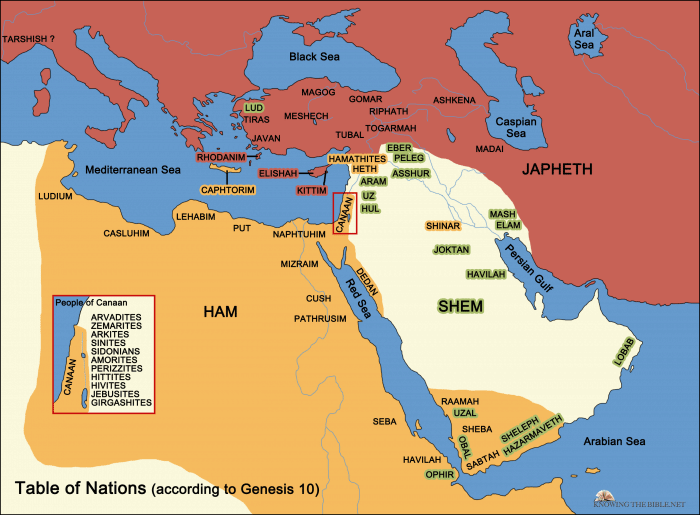
I thought about my friends in places like Ethiopia, Uganda, and South Sudan when I read through the Table of Nations today. It’s tempting from a Western perspective to think in terms of modern “nation-states” as if the names mentioned represent an exhaustive list of ancient kingdoms that filled the earth. But we have to always remember - especially when reading the Old Testament - that though the Bible was written for us, it was not written to us. It was written to a relatively small group of people in the ancient near east who thought of families and clans and tribes rather than nations and empires. It is far more likely that the Table of Nations shows the spread of actual people known to the biblical author and establishes a framework that will undergird how the descendants of Noah’s family - what will become ancient Israel - interacts with the nations around them. The number of nations listed equals the number 70 which is a highly significant symbolic number in the Bible, often representing the number of completion. So we most likely need to read this chapter as an intentional theological outline rather than an exhaustive ethnic census.
What does all that mean for us today? Well, it helps us understand the “tribal” impulses that exist in every human being which may explain why even in a Western country like America, it is so easy for us to fall into political tribes or identity politics. It’s gives us insight into why there is so much conflict and strife between families and clans and tribes. For example, in Somalia, the people often talk about “family against clan, clan against tribe, tribe against nation, and nation against the world.” This philosophy is not limited to just the Somali’s. Consider some of the extreme rhetoric around “America First” in our own country. There’s just a sinful impulse inside us all that wants to define ourselves over and against others who are different. But Christ comes to tear down every dividing wall of hostility. Christ comes to transcend every cultural barrier. Christ comes to bridge every divide between all the different tribes on earth which is why in Revelation 7:9 you see every tribe. Every tongue. Every nation. All gathered together in worship before the throne. And this is what the church is called to reflect in our present world.
Readings for tomorrow: No devotionals on Sundays